District of Columbia Power Outage Preparedness
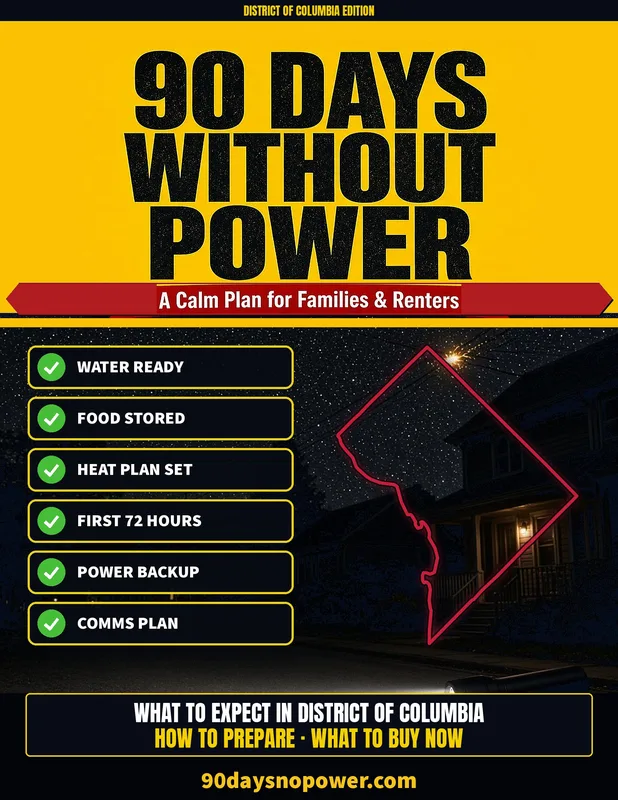
The District of Columbia edition of 90 Days Without Power by 90daysnopower.com adds Heat, flood, and ice edition for the District to the national household plan. Use official District of Columbia emergency information together with Ready.gov, CDC, EPA, and USDA baselines for water, food, heat and cold, and carbon monoxide.
Get the District of Columbia state add-on
Instant download after purchase: open the PDF on your phone, tablet, or computer the same day. Print pages at home, or take the file to a local print shop for hard copies. Fillable Family Emergency Cards are included with regional Premium editions and the All-States Library.
Print it your way — home printer, FedEx Office, Walgreens Photo, Staples, or The UPS Store. Check your local store for pickup timing.
The District of Columbia add-on is $10 and pairs with the universal General guide ($18). General + District of Columbia is $28.
Northeast Premium — $38 includes the General guide, the fillable Family Emergency Cards, and all 12 states in the region: Connecticut, Delaware, District of Columbia, Maine, Maryland, Massachusetts, New Hampshire, New Jersey, New York, Pennsylvania, Rhode Island, and Vermont.
Look inside
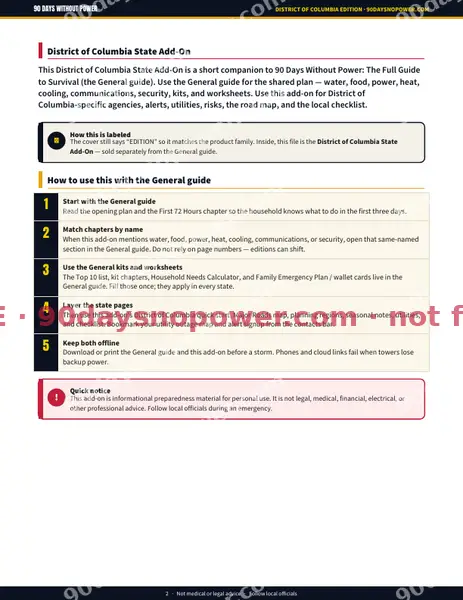
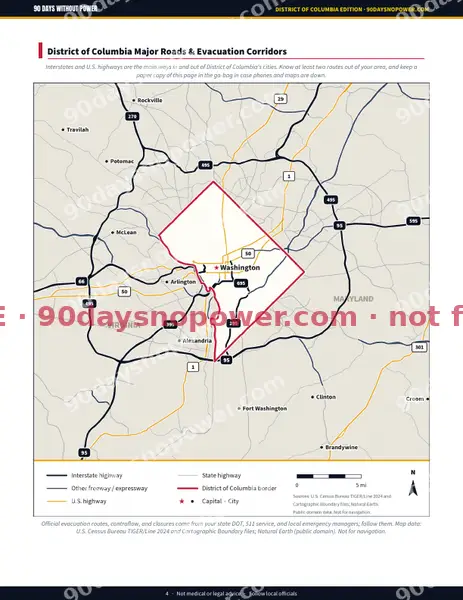
Small watermarked samples for on-screen preview only. They are low resolution and marked so they are not useful for printing. The purchased PDF is the full print-ready edition.
Who to listen to in District of Columbia
DC Homeland Security and Emergency Management Agency (HSEMA) / ReadyDC is the state emergency-management agency named in this edition. The public information network listed in the book is AlertDC (Districtwide Everbridge) + WEA / EAS. For local help lines, Dial 2-1-1 or visit the DC 211 Warmline site for free connections to local resources. Availability and hours may vary; check the official site.
Open the 2-1-1 page listed for District of Columbia
Climate and risk notes
The District is a dense Mid-Atlantic city on the Potomac and Anacostia: summer heat and humidity; winter ice and occasional nor'easters; and river flooding after heavy rain.
The District sits in a dense Mid-Atlantic grid with summer heat, winter ice, and tropical remnants. Local AlertDC notices and utility outage maps are the first places to look.
Risks this edition emphasizes
- Extreme heat when A/C stops after storms.
- Ice storms and winter storms that ice trees onto lines.
- River and flash flooding that slow restoration.
- Severe thunderstorms that snap poles.
- Carbon monoxide after storms, because portable generators and unsafe indoor heat are common during recovery.
Documented outages and official reviews cited in the book
- Heat waves, ice, flooding, and severe storms can darken District neighborhoods for hours to many days. Pepco publishes outage tools — bookmark the map for your meter before the forecast turns. Cite Pepco's own outage map rather than a remembered customer count.
- A household that already keeps a heat or winter kit is partway to a longer plan — the usual gaps are water volume, medical refrigeration, a one-cool-room or one-warm-room plan, and CO-safe generator habits.
The grid, in plain language
The District sits in the Eastern Interconnection (not ERCOT). Pepco is the primary electric distribution utility for the District; neighboring Maryland utilities serve nearby suburbs. Know that Pepco owns the lines to your meter in the District and bookmark its outage map before heat, flood, or ice season.
Official utility and warning links used in the edition
Water, heat, and cold in District of Columbia
Municipal water is treated and pumped electrically. After flooding or a boil-water notice, assume tap water may be unsafe until officials say otherwise. Store bottled water before a storm.
Humidity is the multiplier in the District. Older adults, young children, and people with heart disease are at higher risk. DC HSEMA, AlertDC heat alerts, and the 211 Warmline are the right places to ask about cooling centers (availability and hours may vary; check the official site).
A running car is not a bedroom. A generator in a garage (even with the door open) or on a porch is still too close. Never heat with a gas stove or oven. Point generator exhaust away from the house and neighbors.
Seasonal reminders
- Winter
- Spring
- Summer heat
- Fall / heavy rain
Household priorities in this edition
- Bookmark DC HSEMA / ReadyDC; enable Wireless Emergency Alerts; and register for AlertDC as HSEMA describes (availability and hours may vary; check the official site).
- Save Pepco's outage map and turn on Pepco outage alerts for your meter.
- Write a multi-day heat plan and an ice/flood go-bag plan — the District needs both.
- Place any generator 20+ feet outdoors with exhaust pointed away from openings; never use a gas stove or oven to heat a home.
- Keep a paper District / metro area atlas or ward map in the go-bag for when cell maps fail.
Checklist extras for District of Columbia
- Bookmark hsema.dc.gov AlertDC; enable WEAs; complete AlertDC registration (availability and hours may vary; check the official site)
- Save Pepco's outage tool for your meter and turn on outage alerts
- Write a multi-day heat plan before summer
- Pack a flood go-bag and know two ways out of low-lying neighborhoods
- Write the outdoor parking spot for a generator, 20+ feet from doors and windows
- Test CO and smoke alarms before summer heat and winter ice season
- If someone uses refrigerated medicine, write the storage range from the label
- Put a District / metro paper atlas or ward map in the go-bag
- Keep a paper list: 911, 2-1-1, Poison Help 1-800-222-1222, 988, Disaster Distress 1-800-985-5990. Availability and hours may vary; check the official site.
- After flooding, follow official boil-water guidance before using tap water
Self-defense statute note (not legal advice)
The District of Columbia edition includes this short, sourced note so readers know where to read the current law. It is not legal advice and it is not permission to use force. Statutes change; read the official text.
District of Columbia law recognizes self-defense and defense of others as justifications for the use of force. D.C. Code § 22-4503.03(f) provides that it shall be a defense to liability under that section (endangerment with a firearm) that the person discharged a firearm under circumstances constituting lawful self-defense or defense of others. D.C. Code § 23-115 limits certain defenses: for purposes of proving self-defense, defense of others, or defense of property, the defendant was not justified in using force if the basis for their belief in imminent danger was based on discovery of, knowledge about, or the potential disclosure of the victim's actual or perceived gender identity, gender expression, or sexual orientation. Broader self-defense doctrine in the District is developed through case law rather than a single stand-your-ground statute. Read the current District of Columbia Official Code. Sources: https://code.dccouncil.gov/us/dc/council/code/sections/22-4503.03 and https://code.dccouncil.gov/us/dc/council/code/sections/23-115. This is general information, not legal advice. Laws change; readers should check the current statute text and local ordinances or consult a licensed attorney.
Related national guides: how to prepare for a 90-day blackout · water storage · home security · staying cool · staying warm
The District of Columbia add-on is $10 and pairs with the universal General guide ($18). General + District of Columbia is $28.
Northeast Premium — $38 includes the General guide, the fillable Family Emergency Cards, and all 12 states in the region: Connecticut, Delaware, District of Columbia, Maine, Maryland, Massachusetts, New Hampshire, New Jersey, New York, Pennsylvania, Rhode Island, and Vermont.